Original Content
candidate_metadata: candidate_id: “C00786” title: “Bank of Korea Governor Warns Private Stablecoins Risky, Proposes Central Bank Model” source_name: “조선일보” source_domain: “www.chosun.com” url: “https://www.chosun.com/english/market-money-en/2026/07/01/QAO75WCX5VFIHNFVH3CM6YQDCQ/” canonical_url: “https://www.chosun.com/english/market-money-en/2026/07/01/QAO75WCX5VFIHNFVH3CM6YQDCQ/” published: “2026-07-01” collected: “2026-07-30T23:59:57Z” query: “tokenized deposits bank-issued digital money” snippet: “title_gate_include_and_body_term_confirmed” candidate_id: “C00786” title: “Bank of Korea Governor Warns Private Stablecoins Risky, Proposes Central Bank Model” source_url: “https://www.chosun.com/english/market-money-en/2026/07/01/QAO75WCX5VFIHNFVH3CM6YQDCQ/” canonical_url: “https://www.chosun.com/english/market-money-en/2026/07/01/QAO75WCX5VFIHNFVH3CM6YQDCQ/” source_domain: “www.chosun.com” source_type: “article” author: “Shinyoung Kim” published: “2026-07-01” collected: “2026-07-30” original_language: “korean” registered_by: “hermes” registered_at: “2026-07-30T23:59:57Z” collector_note: “Source-success web_extract_markdown; body review AUTO_RULE INCLUDE; source artifact SHA-256 3ce644141a1f7ad2180ec68b8b65c4da6bfdd2c7bdb432862d32c67b9fde691a; extracted body SHA-256 2be24221a1b5d8022c2ecb74ab42f59738fce36c25d48c284ee55b6a0188a2d8.”
Bank of Korea Governor Warns Private Stablecoins Risky, Proposes Central Bank Model
원문 추출 본문
Title: Bank of Korea Governor Warns Private Stablecoins Risky, Proposes Central Bank Model
URL Source: http://www.chosun.com/english/market-money-en/2026/07/01/QAO75WCX5VFIHNFVH3CM6YQDCQ/
Published Time: 2026-07-01T08:45:32.276Z

Bank of Korea Governor Warns Private Stablecoins Risky, Proposes Central Bank Model
Shin Hyun-song advocates integrated ledger system with central and commercial banks to ensure stability, citing risks of private stablecoin volatility and trust issues
Published 2026.07.01. 17:45 Updated 2026.07.01. 21:01
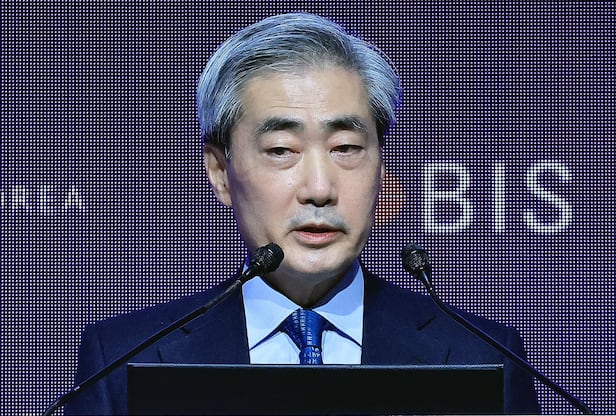
Bank of Korea Governor Shin Hyun-song presents a two-tier digital currency model built by central banks and private banks at the ‘ECB Forum’ held in Sintra, Portugal, on the 1st. The photo shows Governor Shin delivering a keynote speech at an international conference held at the Bank of Korea in 2024. /News1
Bank of Korea Governor Shin Hyun-song warned about the risks of private stablecoins and suggested that a digital currency led by central banks and commercial banks would be more suitable. Governor Shin presented a related paper at the ‘European Central Bank (ECB) Forum’ held in Sintra, Portugal, on July 1, stating, “The next stage of monetary innovation is ‘tokenization,’ which can embed transaction conditions and execution rules into money. The issue with private stablecoins, as entities implementing this technology, is that their value fluctuates if the issuer’s credibility is shaken. This drawback could be mitigated by establishing an ecosystem involving central banks and commercial banks, where trust is already secured.”
Stablecoins are virtual currencies (coins) designed to have their value fixed to legal tender, such as “1 coin = 1 Korean won” or “1 coin = 1 dollar.” Currently, 99% of circulating private stablecoins are pegged to the U.S. dollar, like Tether and USDC. While these stablecoins, which are growing in transaction volume, offer advantages such as reduced costs and time compared to traditional financial systems by using blockchain technology, experts argue they are not truly “stable” because their value can deviate during market shocks.
Governor Shin stated, “The decentralized blockchain used by private stablecoins requires constant rewards for participants, and as safety measures increase, costs and fees surge, causing users to scatter in search of cheaper options. Money gains power only when everyone uses it together, but if those using money are scattered, it becomes a problem.” Having previously held a negative stance on private stablecoins during his tenure as Head of the Monetary and Economic Department at the Bank for International Settlements (BIS), Governor Shin softened his position during his National Assembly confirmation hearing in April, stating that central bank digital currencies (CBDCs) and stablecoins could coexist. However, in this speech, he reverted to emphasizing risks.
Governor Shin proposed a digital currency system where central banks and commercial banks jointly participate, centered around a digital integrated ledger, as a solution to the issues with current stablecoins. He explained, “The integrated ledger serves as a new stage where money and assets converge, allowing tokenized central bank money, tokenized bank deposits, and tokenized assets like government bonds to be traded together. When money and assets share the same ‘stage,’ transactions can be processed more simply and securely.” The “integrated ledger” refers to a digital ledger designed for collective use, unlike the fragmented ledgers managed separately by companies and institutions. “Tokens” denote digitized currencies or assets traded digitally. Since his time at the BIS, Governor Shin has led cross-border digital currency experiments like “Project Agora,” designing a “two-tier” system where central banks provide support and commercial banks execute operations.
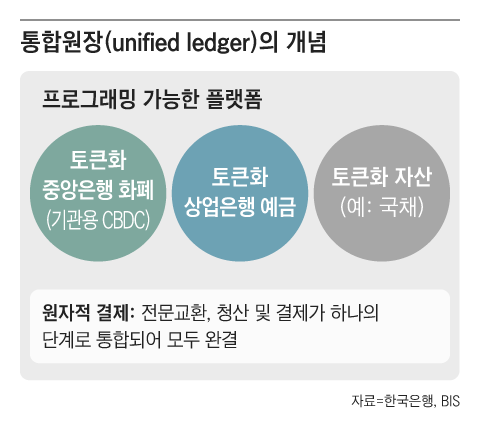
The concept of the integrated ledger presented by Governor Shin Hyun-song at the ECB Forum. Tokenized central bank money, tokenized commercial bank deposits, and tokenized assets are connected within a single ledger. Graphics by Chosun Design Lab Kim Yeon-ju
Governor Shin defined tokenization as “a method that goes beyond converting money into digital numbers on a screen, embedding transaction conditions and execution rules together.” He added, “This applies not only to money but also to assets like government bonds and stocks, and the integrated ledger is the stage where this ‘smart’ money and assets converge.” He explained, “Currently, when trading assets, the timing of payment and asset transfer can mismatch, risking losses if one party fails to fulfill their promise. On an integrated ledger, all processes occur simultaneously, ensuring transactions are executed simply and securely without discrepancies.”
As an example of “smart money,” he cited the Bank of Korea’s pilot digital currency project, “Project Hangang,” conducted with commercial banks. The first phase, which ran from April to June last year, allowed pre-registered consumers to make payments using deposit tokens at designated merchants. The second phase, involving nine banks, is set to proceed in the second half of this year. This phase expands the system’s use from payments to remittances via a mobile app, with banks issuing deposit tokens within a framework jointly built by the Bank of Korea and commercial banks. Yoon Seong-gwan, Head of the Bank of Korea’s Digital Currency Office, stated, “Project Hangang is the world’s first case of implementing an integrated ledger involving a central bank in real transactions.”
Governor Shin noted, “In the second phase of Project Hangang, the programming functionality of money will be applied to government fiscal expenditures, with subsidies for electric vehicle charging infrastructure and public sector operational funds being the first test cases. This is expected to reduce settlement times and lower fees.” Currently, after disbursing national funds, post-hoc audits and settlements are conducted, making it difficult to recover misused funds. The Bank of Korea anticipates this system will mitigate such issues. Governor Shin added, “By programming money, we can set conditions so that qualified businesses use national funds only for permitted purposes within specified periods, preventing misuse and reducing resources spent on post-hoc audits. Additionally, shortening intermediary steps in fund transfers is expected to lower transaction fees.”
· This article has been translated by Upstage Solar AI.
원문보기 (View Original Korean Article)
Editor’s Pick

Exclusive: South Korean Military Unaware of U.S. Training, Nearly Shoots Down Drone
4h ago
|Yang Ji-ho,Kwon Soon-wan

Trump Announces Disarmament Agreement With Hamas
1h ago
|You Jin-woo (ChosunBiz)

South Korea’s Triple Increase in Production, Consumption, Investment
39m ago
|Jung Seok-woo
Most Read News
1
Kang Mi-na Sheds 13kg for Office Drama Role
2
Trump’s Career Mirrors Godzilla in Political Study
3
Kwak Dong-yeon Admits Limited Bonding with Nam Joo-hyuk on Set
4
SK Hynix Surges 16% in Premarket After Wall Street Rally
5
Big Tech’s $5.3T AI Arms Race Fuels Semiconductor Demand
6
Free Bus Rides Spur Senior Surge in Daegu Shops, Parks
7
Yoon Kyung-ho Hopes for Season 2 With Co-Stars
8
‘We’ll Defeat the Market’: Government Powerless Against Market Backlash
9
Exclusive: South Korean Military Unaware of U.S. Training, Nearly Shoots Down Drone
10
Apple’s Strong Results, Weak Outlook on Component Shortages
6
Free Bus Rides Spur Senior Surge in Daegu Shops, Parks
7
Yoon Kyung-ho Hopes for Season 2 With Co-Stars
8
‘We’ll Defeat the Market’: Government Powerless Against Market Backlash
9
Exclusive: South Korean Military Unaware of U.S. Training, Nearly Shoots Down Drone
10
Apple’s Strong Results, Weak Outlook on Component Shortages
National | Market & Money | Industry | North Korea | Entertainment+ | Lifestyle | World | Opinion | Sports
Terms of Service | Privacy Policy | About Us | E-mail :englishchosun@chosun.com
Copyright Chosunilbo All rights reserved.
로그인을 하시면 모든 기사를 읽을 수 있습니다
로그인
휴대폰 로그인 이메일 로그인
이메일 혹은 아이디
비밀번호
로그인
- 로그인 상태 유지
소셜 로그인


Sign in with Google. Opens in new tab

로그인 아이디가 없으신가요? 회원가입
로그인이 어려우신가요?상세설명 보기